
Jump Around Party Rentals - Planning Guide
How to Anchor a Bounce House on Grass, Concrete, and Other Surfaces
Proper anchoring is the most important safety step in any bounce house setup. This guide covers every surface type Jump Around Party Rentals encounters across Greater Austin - from suburban grass to concrete driveways to open ranch fields.
William Gann
Owner, Jump Around Party Rentals
Why Anchoring Is the Most Important Part of Setup
A bounce house that is not anchored correctly is not a safe bounce house. The physics are straightforward: kids jumping inside create constant lateral force, internal air pressure pushes outward against the walls, and even a light breeze adds lift that most people underestimate until they see it happen. An unanchored or poorly anchored inflatable can shift, tip, or in extreme wind conditions lift entirely off the ground.
At Jump Around Party Rentals, anchoring is the step we take most seriously on every single delivery. Our crew does not hand off the controls and leave until every stake or sandbag is set and tested. The surface determines the method - and after 16 years of delivering bounce houses across suburban grass, concrete driveways, ranch properties, and city parks, we have seen every anchoring situation this region throws at an inflatable.
This guide covers what our crew does on every surface type we encounter in the Greater Austin Metro - from the lawns of Cedar Park bounce house rentals and bounce house rentals in Georgetown to the ranch properties of Liberty Hill and Florence.
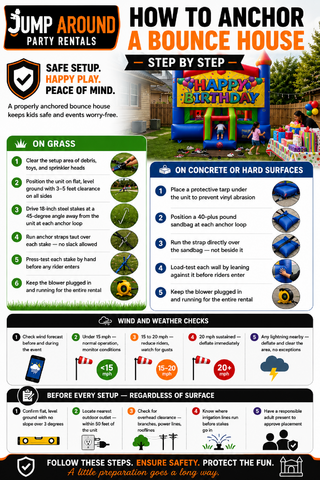
Jump Around Party Rentals anchoring guide
Anchoring on Grass - The Ideal Surface
Grass is the best anchoring surface for inflatables. Soil allows for deep-ground stakes that create resistance in multiple directions simultaneously - against the lateral push of jumpers, the outward pressure of air, and the upward lift of wind. A properly staked bounce house on healthy turf is about as stable as an inflatable gets.
What Jump Around Party Rentals Does on Grass
- 18-inch heavy-gauge steel stakes driven at a 45-degree angle away from the unit - this angle creates resistance against both lateral and upward forces simultaneously
- One stake per anchor loop at minimum - larger units get additional stakes at midpoints along each wall
- Stake depth confirmed by hand pressure test before any rider enters
- All anchor straps run taut with no slack - slack allows movement that accumulates into larger shifts under load
Grass Conditions That Require Extra Care
Dry or Compacted Turf
Hard-packed Central Texas summer ground reduces stake penetration. We drive stakes deeper and test resistance before setup is complete. During long droughts, watering the setup area the night before significantly improves holding power.
Recently Watered or Saturated Ground
Waterlogged soil holds stakes poorly. If the ground is saturated from recent rain, we use longer stakes and add supplemental sandbags. We also check that the surface drains adequately for safe footing around the unit.
Sloped Yards
We do not set up on slopes steeper than approximately 3 degrees without a specific safety assessment. A tilted bounce house creates uneven rider dynamics and uneven anchor load. Call before booking if your yard has significant grade.
Ranch and Rural Properties
Open-field ranch setups in Liberty Hill and Florence TX often involve native grass and caliche subsoil. We carry longer stakes for these deliveries and confirm soil conditions when we call ahead before every rural delivery.
Anchoring on Concrete, Asphalt, and Hard Surfaces
Concrete and asphalt are workable surfaces for bounce house setups - they just require a different anchoring method. Stakes obviously do not penetrate hard surfaces, so the anchoring system shifts entirely to weighted ballast: sandbags placed at each anchor point with enough mass to resist the forces a loaded inflatable generates.
What Jump Around Party Rentals Does on Hard Surfaces
- Heavy sandbags (40-plus pounds each) placed at every anchor loop - weight is the only substitute for ground penetration on concrete
- Sandbags positioned as close to the unit base as possible to minimize moment arm - the closer the weight is to the anchor point, the more effectively it resists lateral force
- Straps run directly over the sandbag, not around it - the strap must pass over the mass, not just be adjacent to it
- Load test before any rider enters: crew member leans on each wall and checks for movement
⚠ Important: Concrete Setup Weight Requirements
A standard bounce house on concrete requires a minimum of 40 pounds of ballast per anchor point. A unit with 6 anchor points needs at least 240 pounds of total ballast distributed correctly. Insufficient weight is the leading cause of bounce house movement on hard surfaces. Never substitute light items like water jugs, coolers, or decorative weights for proper ballast.
Concrete Surface Tips for Homeowners
If your event is on a concrete or paved surface, let us know when you book. We bring the appropriate ballast equipment for hard-surface setups at no extra charge. We also place a protective tarp or padding under the unit to prevent vinyl abrasion on rough concrete. Smooth concrete is fine. Cracked, uneven, or heavily aggregate concrete may require additional assessment - mention it when you book.
Wind and Weather - When to Shut Down
Anchoring keeps a bounce house stable in normal operating conditions. It does not make an inflatable immune to wind. Central Texas weather - particularly in spring and during storm season - can shift from calm to 25-mph gusts in minutes. Every renter needs to understand wind shutdown thresholds before the event starts.
Under 15 mph
Normal operation. Monitor conditions.
15 to 20 mph
Caution zone. Reduce riders. Watch for gusts.
20+ mph sustained
Deflate immediately. Do not restart until winds drop.
Any lightning nearby
Deflate and clear the area immediately. No exceptions.
The most important rule: when in doubt, deflate. An inflatable that has been deflated and re-inflated after conditions improve is not damaged. An inflatable that lifts in a gust with a child inside is a different story entirely. See the full bounce house safety guide for complete weather and shutdown protocols.
Parks, Turf, and Special Surface Situations
City Parks
Parks like San Gabriel Park in Georgetown, Elizabeth Milburn Park in Cedar Park, and Conder Park in Killeen have their own surface and anchoring requirements. Some have designated event lawns with healthy turf that takes stakes normally. Others have areas with compacted path soil or concrete pads near pavilions. For any park event, tell us the specific area when you book - we plan the anchoring method in advance rather than improvising on site.
Synthetic Turf
Synthetic turf over compacted base material accepts stakes but with reduced holding power compared to natural soil. We use longer stakes on artificial turf and supplement with sandbags at each anchor point. Do not assume synthetic turf performs identically to natural grass for anchoring purposes.
Mulch and Gravel
Playground mulch and loose gravel are poor anchoring surfaces. Stakes do not achieve adequate soil engagement and the material shifts under load. If the only available space has a mulch or gravel surface, we treat it as a hard-surface setup and rely entirely on sandbag ballast. Call us before booking if this describes your venue.
Indoor Setups
Indoor setups on gym floors, church fellowship halls, and community center floors use sandbags exclusively. The additional advantage indoors is the elimination of wind as a force factor - which significantly reduces the total ballast needed compared to an equivalent outdoor concrete setup. Overhead clearance must be confirmed before booking any indoor inflatable.
Anchoring FAQ
Can I move the bounce house after Jump Around Party Rentals sets it up?
No. Once the unit is anchored and inspected, it must remain in that position for the entire rental. Moving an inflatable requires full deflation, re-positioning, and re-anchoring from scratch. If you need to relocate the unit after setup, call (512) 294-2221 - our crew can return to assist but this is not a DIY operation. See the rental FAQ for more setup and delivery questions.
Do I need to do anything to anchor the bounce house myself?
No. Jump Around Party Rentals handles all anchoring as part of setup. You do not touch the stakes, straps, or sandbags. Your job is to clear the setup area before we arrive and have someone present to approve the placement location. If you are renting a moonwalk or bouncy house for inflatable rentals in Austin TX or anywhere else in the service area, anchoring is completely handled by our crew.
What should I do if the bounce house starts moving during our party?
Remove all riders immediately and call (512) 294-2221. Do not attempt to re-stake or adjust the anchors yourself. Movement during operation usually means either a stake has pulled out in softened soil or wind conditions have exceeded safe operating thresholds. Both require professional assessment before the unit can be used again.
Does Jump Around Party Rentals set up bounce houses on concrete driveways?
Yes. Concrete driveway setups are common across the service area, particularly in neighborhoods where the backyard is not accessible through a standard gate. We bring sandbag ballast for all hard-surface setups. Let us know the surface when you book so we load the correct equipment. Browse bounce house rentals and note your surface type in the order comments. For backyard layout tips before delivery day, see the backyard party layout guide.
Is anchoring handled the same way for water slides as bounce houses?
The same principles apply but water slides require more anchor points and higher ballast weight due to their larger footprint and the additional dynamic load of riders descending the slide. Water slide setups on concrete require significantly more sandbag weight than a standard bounce house. All of this is handled by our crew - see the full range of water slide rentals available across the Greater Austin Metro.
About the Author
William Gann
Owner and Founder, Jump Around Party Rentals • Round Rock, TX • Owner-operated since 2008
William Gann founded Jump Around Party Rentals in Round Rock, Texas in 2008 and has personally overseen thousands of inflatable deliveries across the Greater Austin Metro. With 16 years of hands-on experience setting up bounce houses, water slides, obstacle courses, and carnival rides on every surface type in Central Texas - from suburban lawns to ranch properties to city park events - William writes from direct operational experience, not theory. Jump Around Party Rentals holds 932 verified five-star Google reviews and serves Travis, Williamson, and Bell Counties.
Every Jump Around Rental Includes Professional Setup and Anchoring
You never touch a stake, strap, or sandbag. Our crew handles every surface type across Greater Austin - grass, concrete, parks, and ranch properties across Round Rock, Pflugerville, and the full Greater Austin Metro. TDI-inspected, fully insured, 932 five-star reviews.
(512) 294-2221
