
Safety Guide
Bounce House Safety 101 for Greater Austin Events
By William Gann, Jump Around Party Rentals • Published: April 2024 • Last Updated: June 13, 2025 • Category: Safety • Reading time: 12 min
Age limits, supervision rules, wind and heat thresholds for Central Texas summers, anchoring standards, insurance requirements, and the complete pre-event safety checklist for bounce house rentals in Round Rock, Cedar Park, Georgetown, and across the Greater Austin Metro.
Safe Fun. Happy Guests. Stress-Free Events.
Jump Around Party Rentals has delivered bounce houses and inflatables to backyard parties, school events, church festivals, and community events across Greater Austin since 2008. Safety is not an afterthought — it is the reason families book with us year after year. Every unit is TDI-inspected, cleaned between every rental, and built from lead-free fire-retardant commercial-grade vinyl.
This guide covers:
- Age and weight limits — what actually happens when you mix age groups and why it matters
- Central Texas heat thresholds — specific temperature and surface heat limits for July and August
- Wind limits and weather shutdown — when to deflate and how to make the call
- Anchoring and surface requirements — grass, concrete, and caliche all handled differently
- Supervision standards — adult-to-child ratios, entrance rules, and rotation timing
- Pre-event safety checklist — 20 items to verify before the first child steps inside
Questions before booking? Call (512) 294-2221 or browse the full bounce house rental catalog. Every unit comes with safety documentation and setup by a trained crew.
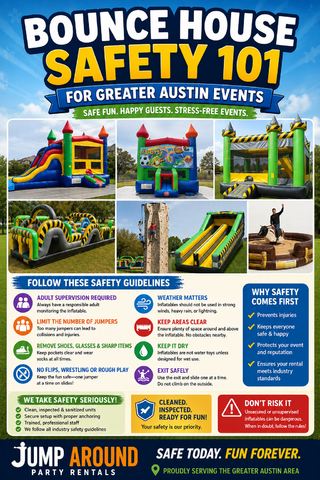
Jump Around Party Rentals — Greater Austin
7 Things Every Parent and Event Planner Needs to Know
Never mix age groups in the same bounce house
An 8-year-old landing near a 3-year-old in an enclosed space creates real injury risk regardless of intent. Age separation is the single most important safety rule more important than capacity, more important than supervision ratio. Toddlers and elementary-age children must bounce separately.
Central Texas wind matters more than you think
The Austin Metro averages 12 to 15 mph sustained winds year-round, with spring gusts reaching 25 to 35 mph. Most bounce houses should be deflated and cleared when sustained winds exceed 15 to 20 mph. Check the forecast that morning not the night before. Weather in Williamson County can shift within hours.
One adult supervisor not a parent nearby at the entrance
One dedicated adult whose only job is managing the bounce house entrance. Not a parent watching from 10 feet away while talking to guests. One adult, one job, no exceptions. This person controls who enters, how many are inside, and removes anyone who is bouncing dangerously.
TDI registration is verifiable and required by Texas law
Every commercial inflatable rental operator in Texas must be registered with the Texas Department of Insurance and pass annual inspection. You can look up any operator at tdi.texas.gov in under 30 seconds. If they are not listed, they are not legal. Jump Around Party Rentals is TDI-registered and verifiable.
Summer heat in Austin changes how you run a bounce house event
June through August in the Austin Metro regularly hits 100 to 108 degrees. Bounce house vinyl absorbs heat in direct sun and the interior temperature rises significantly above ambient. Limit sessions to 10 to 15 minutes per child during peak heat. Schedule events before 11 AM or after 5 PM. Keep cold water within 20 feet of the unit at all times.
Shoes off, jewelry off, glasses off no exceptions
Shoes cause lacerations when they contact other children during bouncing. Jewelry rings, earrings, necklaces can catch on mesh netting or other children during falls. Glasses are a collision hazard. These rules feel minor until they prevent the injury that sends someone to urgent care. Post them visibly at the entrance and enforce them before children enter.
Consumer-grade bounce houses are not the same as commercial equipment
Retail bounce houses from big box stores are not built to the same specifications as commercial rental equipment. They are not TDI-inspected. They use thinner vinyl, smaller blowers, and lighter anchoring systems. A bounce house rented from a licensed operator and a bounce house purchased at a retail store are fundamentally different products with different safety profiles.
Table of Contents
1. Age and Size Guidelines by Unit Type
Age and weight guidelines exist because inflatable equipment is engineered to specific load tolerances. Exceeding them increases the risk of structural failure, blower overload, and collision injury from size disparity. These are manufacturer specifications, not suggestions.
| Unit Type | Recommended Age | Max Riders at Once | Weight Limit (typical) | Key Notes |
|---|---|---|---|---|
| Toddler Bounce House | Ages 2 to 5 | 4 to 6 | Under 100 lbs each | No older children ever. Adult may enter to assist only, not to bounce. |
| Standard Bounce House (13x13) | Ages 3 to 10 | 6 to 8 | Under 150 lbs each | Separate age groups if more than 3 years apart. No adults bouncing. |
| XL Bounce House | Ages 4 to 12 | 8 to 12 | Under 200 lbs each | More space per rider. Still enforce age separation for mixed parties. |
| Combo Bounce House with Slide | Ages 4 to 12 | 6 to 8 | Under 175 lbs each | One rider at a time on slide. Supervisor needed at both bounce entry and slide exit. |
| Water Slide Combo (Wet) | Ages 5 and up | 1 rider per lane | Per unit specs | No toddlers unsupervised. Wet surfaces increase slip risk. Non-swimmer supervision required near pool. |
Weight and capacity limits vary by specific unit. Always confirm with Jump Around Party Rentals at time of booking. When in doubt, lower the capacity a less crowded bounce house is a safer bounce house.
2. Supervision Rules and Capacity Management
The One-Adult Rule
One adult whose only job is the bounce house entrance. Not a parent with one eye on the bounce house and one eye on the dessert table. This adult controls admission, enforces capacity limits, removes shoes and jewelry before entry, and stops unsafe behavior inside. For parties with 20+ kids, assign two adults one at the entrance and one watching the interior through the mesh window.
Capacity Enforcement
Capacity limits are not arbitrary. They are calculated based on the floor space and structural load of the inflatable. When the bounce house is at posted capacity, no additional riders enter period. Rotate kids in groups of 5 to 10 minutes. This also helps manage heat exposure during summer events.
Behaviors to Stop Immediately
- Flipping, somersaults, or wrestling
- Bouncing near the entrance opening
- Climbing the exterior walls or netting
- Overcrowding in one corner
- Older kids rough-bouncing near toddlers
- Anyone entering or exiting while others are bouncing at full speed
Adults in the Bounce House
Adults should not bounce alongside children. An adult's weight in a bounce house with children creates significant size disparity and collision risk. An adult may enter to comfort a distressed toddler or retrieve a fallen child but should stand still and exit promptly. Never bounce with children regardless of the child's age.
3. Weather Safety Wind, Heat, and Lightning
Wind Thresholds
| Wind Speed (Sustained) | Action Required | Notes |
|---|---|---|
| Under 15 mph | Safe to operate | Normal operation. Monitor conditions throughout event. |
| 15 to 20 mph | Caution monitor closely | Reduce capacity. Clear immediately if gusts exceed 20 mph. Check forecast every 30 min. |
| 20 to 25 mph sustained | Clear and deflate | All riders exit. Do not re-inflate until winds drop below 15 mph sustained for 30 minutes. |
| 25+ mph or gusts over 30 mph | Do not operate | Event suspended. Staked units hold at these speeds but anchor failure risk increases significantly. |
Lightning Protocol
The 30-30 rule: if the time between a lightning flash and thunder is 30 seconds or less, clear all inflatables immediately and move everyone indoors or to a hard-topped vehicle. Do not resume outdoor activity until 30 minutes after the last thunder. In Central Texas, afternoon pop-up storms can develop within 30 minutes with minimal forecast warning especially July through September.
Rain
Light rain does not automatically require deflation, but creates slip hazards at the entrance ramp and inside the bounce area. Heavy rain creates visibility issues for the supervisor. When in doubt, clear riders and wait. A 15-minute rain pause is far better than a slip injury.
4. Austin Metro Month-by-Month Heat Safety Guide
Central Texas heat affects bounce house safety differently from one month to the next. This table reflects Austin Metro averages for Round Rock, Cedar Park, Georgetown, Leander, and surrounding Williamson County cities.
| Month | Avg High (Austin) | Peak Heat Window | Best Event Timing | Heat Precautions |
|---|---|---|---|---|
| Jan / Feb | 58 to 62F | N/A | Any time ideal | None needed. Cold weather operation is fine. |
| March / April | 72 to 80F | 1 to 4 PM | Morning or afternoon | Minimal. Water available. Monitor kids. Watch wind spring gusts common. |
| May | 85 to 90F | 12 to 5 PM | Before 11 AM or after 5 PM | Hydration enforced. 20-min rotation for kids under 8. Shade for waiting area. |
| June | 95 to 100F | 11 AM to 6 PM | Before 11 AM or after 6 PM | 10 to 15 min max sessions. Cold water mandatory within 20 ft. Consider water slide instead. |
| July / Aug | 100 to 108F | 10 AM to 7 PM | Before 10 AM or after 7 PM | 10 min max sessions. Mandatory 5-min shade break between sessions. Water slide strongly preferred for peak heat. |
| September | 93 to 98F | 12 to 5 PM | Before 11 AM or after 5 PM | Similar to June. Heat lingers into evening. Watch heat index humidity increases in Sept. |
| October / Nov | 72 to 83F | 1 to 4 PM (Oct) | Any time ideal | Best outdoor event months in Central Texas. Minimal heat precautions needed. |
| December | 58 to 64F | N/A | Any time | Cold weather comfort consider propane heater for seating areas. No heat risk. |
Temperature data reflects 30-year averages for Austin/Round Rock area. Always check the day-of forecast Central Texas temperatures can vary 10 to 15 degrees from average. Heat index values with humidity can push feels-like temperatures 5 to 10 degrees higher.
5. Anchoring and Surface Standards
Grass Installation
Ground stakes through anchor loops into the soil. Austin Metro soil is predominantly expansive clay (known locally as "black gummy") which holds stakes well when moist but can become hard and brittle in drought conditions. Jump Around Party Rentals crews check stake depth and resistance before leaving every setup.
Concrete and Asphalt
Sandbag anchoring on hard surfaces. Sandbags are positioned at each anchor point and connected to the inflatable. Heavier and more time-consuming than staking but equally secure when done correctly. Confirm your surface type at booking so the crew brings the right equipment.
Artificial Turf
Many newer Williamson County neighborhoods have artificial turf backyards. These can be staked in the same way as grass when the turf base allows penetration, or sandbag anchored when it does not. Mention artificial turf at booking it affects setup time and equipment.
Clearance Requirements
Standard bounce houses need 3 feet of clearance on all four sides and above the highest point of the unit. Keep the area free of fences, trees, power lines, and other structures within the clearance zone. Low-hanging tree branches are a common issue in established Round Rock and Cedar Park neighborhoods mention them at booking.
6. What a Safe Bounce House Operator Looks Like
The bounce house itself is only as safe as the company that rents it. These are the non-negotiable standards a professional operator meets and what separates a licensed company from an unregistered one operating out of a truck.
| Standard | Professional Operator | Unlicensed Operator |
|---|---|---|
| TDI Registration | Verified at tdi.texas.gov annual inspection on file | Not in TDI database operating illegally under Texas law |
| Commercial Insurance | COI produced immediately on request names venue as additional insured | No commercial policy your homeowner insurance may bear liability |
| Equipment Grade | Commercial-grade PVC vinyl lead-free, fire-retardant, reinforced seams | Consumer-grade retail equipment thinner vinyl, lighter construction |
| Cleaning Protocol | Sanitized after every single rental documented process | Unknown no standard cleaning process |
| Anchoring | Crew stakes or sandbags before leaving checks each point | May deliver and leave without proper anchoring |
| Business Address | Verified physical address accountable business entity | Facebook page and cell number only no physical accountability |
| Reviews | Hundreds of verified Google reviews over years consistent track record | Few or no verifiable reviews no track record |
Jump Around Party Rentals meets every standard in the professional column. For a complete vendor vetting guide, read How to Vet a Party Rental Company in Greater Austin.
7. Pre-Event Safety Checklist Print and Post
Run through this checklist before the first child enters. Post a copy at the bounce house entrance for your supervisor to reference during the event.
Before Setup Verify With Your Rental Company
At the Entrance Before First Rider
During the Event Ongoing Monitoring
8. Frequently Asked Bounce House Safety Questions
What is the maximum wind speed for a bounce house?
Most commercial bounce houses should be cleared and deflated when sustained winds reach 20 to 25 mph. At 15 mph, begin monitoring closely and reduce capacity. At 25+ mph sustained or gusts over 30 mph, do not operate. Central Texas spring events are at highest risk March through May afternoon winds regularly reach 20 to 30 mph in the Austin Metro. Check the hourly forecast that morning, not the night before. See the full rental safety FAQ for additional weather guidance.
Can adults go in a bounce house with kids?
Adults should not bounce alongside children in the same unit. The size and weight disparity creates significant collision risk. An adult may enter to comfort or retrieve a young child but should stand still and exit promptly. Adult-only bounce sessions are fine when children are not present. For events with teen and adult crowds, consider units rated for adults such as the XL Bounce House or interactive inflatables designed for older participants.
How do I know if a bounce house company is safe in Texas?
Search for the company at tdi.texas.gov under the amusement ride safety lookup. Every legitimate commercial inflatable operator must appear in the TDI database. Also request a COI any licensed operator produces one instantly. Jump Around Party Rentals is TDI-registered and COI-ready for every event type. For a full eight-question vetting process, read the vendor vetting guide.
What happens if it rains during our bounce house rental?
Light rain does not require deflation but creates slip hazards at the entrance ramp and inside the bounce area. Clear riders during heavy rain and wait for conditions to improve. If lightning accompanies the rain, apply the 30-30 rule all riders out and unit deflated until 30 minutes after the last thunder. Jump Around Party Rentals has a written weather and cancellation policy. Ask for it at booking so you know your options before event day.
How hot is too hot for a bounce house in Austin?
There is no single temperature threshold it depends on session length, shade, and hydration availability. At 100+ degrees (common in Austin from late June through August), limit bounce sessions to 10 minutes maximum with mandatory 5-minute shaded water breaks. Schedule bounce activity before 11 AM or after 5 PM. For midsummer events, a water slide is a better choice than a standard bounce house the continuous water flow keeps participants cooled through evaporative effect. Read the Central Texas heat guide for full summer event protocols.
William Gann
Owner, Jump Around Party Rentals — Round Rock, TX
William Gann has owned and operated Jump Around Party Rentals since 2008, delivering inflatables to families, schools, churches, and businesses across the Greater Austin Metro. The safety protocols in this guide reflect 15+ years of real delivery experience the anchoring failures he has seen, the weather events he has deflated through, and the age-separation incidents he has worked to prevent. This is not generic advice. It is what has worked at actual Greater Austin events.
Jump Around Party Rentals is fully TDI-compliant, commercially insured, and has earned 4.76 stars across 932 customer reviews. Every unit in the catalog is cleaned and sanitized after every rental.
About William and Jump Around Party RentalsBook a Safe, State-Inspected Bounce House for Your Next Event
Jump Around Party Rentals delivers TDI-inspected, commercially insured bounce houses across Williamson County, Travis County, Bell County, and the Greater Austin Metro. Professional crew, proper anchoring, sanitized equipment. Owner-operated since 2008.
Prices shown are base rates. Pricing may vary for peak dates, extended durations, delivery distance, or setup surfaces. Taxes not included.
(512) 294-2221
