
Outdoor Event Planning Guide
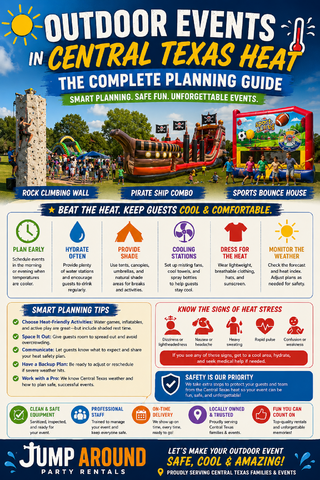
Outdoor Events in Central Texas Heat The Complete Planning Guide
By William Gann, Jump Around Party Rentals • Published: June 2024 • Last Updated: June 13, 2025 • Category: Outdoor Events • Reading time: 13 min
Month-by-month heat risk data for the Austin Metro, heat index thresholds for inflatable operation, shade and cooling station setup, mandatory hydration protocols, equipment comparison by heat performance, and a complete weather shutdown procedure for outdoor events across Williamson and Travis counties.
The Complete Planning Guide for Outdoor Events in Central Texas Heat
Planning an outdoor party or event in the Austin Metropolitan Area means planning around the heat — not hoping it cooperates. June through September in Central Texas is a different animal than anywhere else. This guide gives you real temperature data, equipment-specific safety windows, and the protocols that keep guests safe and events running through the hottest months of the year.
What this guide covers:
- Month-by-month heat calendar — average highs, heat index data, and the worst windows to avoid
- Equipment heat performance — which inflatables handle summer heat and which need time limits
- Shade and cooling setup — tent placement, misting fans, and snow cone station positioning
- Hydration protocols by age — different rules for toddlers, kids, teens, and adults
- Weather shutdown procedure — when to deflate, how to make the call, and what to tell guests
- Morning vs evening event timing — the scheduling strategy that makes summer events work
Planning a summer event? Call (512) 294-2221 or browse the water slide rental options — the right equipment choice makes summer heat manageable.
Jump Around Party Rentals — Austin Metropolitan Area
6 Things That Make Central Texas Heat Different From Anywhere Else
It does not cool down in the evening not really
Coastal heat breaks at sunset. Central Texas holds it. During heat waves, overnight lows in Round Rock and Georgetown stay above 80 degrees. By 6 PM after a 105-degree day, the air is still 95. "Evening party" does not mean comfortable party from June through mid-September without active cooling measures.
Dark vinyl absorbs radiant heat the inside of a bounce house is hotter than the air
Commercial inflatable vinyl in direct midday sun can surface-heat to 20 to 30 degrees above ambient air temperature. At 100 degrees outside, bounce house interior surfaces can reach 120 to 130 degrees. This is why shade positioning is not optional in July it is the difference between a comfortable bounce session and a dangerous one.
Toddlers and kids under 8 cannot thermoregulate as effectively as adults
Children's bodies produce more heat per pound of body weight than adults and dissipate it less efficiently. They also communicate heat distress later by the time a 4-year-old tells you they feel sick, heat illness may already be developing. Enforce breaks proactively. Do not wait for symptoms.
September is as dangerous as July sometimes more so
Most families mentally shift out of "summer heat mode" after Labor Day. September in the Austin Metro averages 93 to 98 degree highs and adds rising humidity that drives heat index values above actual temperature. Many heat incidents at outdoor events happen in September because hosts have let their guard down after a long summer.
A water slide is not just more fun it actively manages heat risk
Evaporative cooling from continuous water contact drops a rider's core temperature meaningfully during each run. A child coming off a water slide is cooler than when they went up. A child coming out of a dry bounce house in July is hotter. The choice between a bounce house and a water slide for a summer event is partly a heat management decision, not just an activity preference.
Pop-up thunderstorms can develop with almost no warning
Central Texas summer afternoons regularly produce pop-up thunderstorms that are not in the morning forecast. By 2 PM on a July day, convective cells can develop within 30 minutes. Check radar on your phone during any afternoon summer event not just the morning forecast. Have a deflation plan ready before weather develops.
Table of Contents
1. Austin Metro Month-by-Month Heat Calendar for Outdoor Events
Temperature data reflects 30-year normals for the Austin-Round Rock metro area. Williamson County cities (Round Rock, Cedar Park, Georgetown, Leander, Hutto) typically run 1 to 3 degrees hotter than downtown Austin due to the urban heat island effect and less tree canopy in newer subdivisions.
| Month | Avg High | Record High (Austin) | Avg Low | Heat Risk Level | Peak Danger Window | Best Event Window |
|---|---|---|---|---|---|---|
| January | 60F | 90F | 40F | None | N/A | Any time cold comfort may need heater |
| February | 64F | 92F | 43F | None | N/A | Any time best outdoor inflatable weather |
| March | 73F | 98F | 52F | Low | N/A | Any time monitor wind (spring gusts common) |
| April | 80F | 100F | 59F | Low | 2 to 5 PM on warm days | Any time light hydration precautions afternoon |
| May | 87F | 103F | 66F | Moderate | 12 to 5 PM | Before 11 AM or after 5 PM hydration required |
| June | 95F | 109F | 74F | High | 10 AM to 7 PM | Before 10 AM or after 7 PM water slide strongly preferred |
| July | 99F | 112F | 77F | Extreme | 9 AM to 8 PM | Before 9 AM or after 7:30 PM water slide required for extended activity |
| August | 101F | 112F | 77F | Extreme | 9 AM to 8 PM | Same as July hottest month on record for Austin |
| September | 95F | 111F | 72F | High | 10 AM to 7 PM | Before 10 AM or after 6 PM humidity raises heat index above air temp |
| October | 82F | 102F | 61F | Low to Moderate | 1 to 4 PM on warm days | Any time best fall event month. Light precautions warm afternoons. |
| November | 71F | 93F | 50F | None | N/A | Any time ideal outdoor weather |
| December | 62F | 85F | 42F | None | N/A | Any time add propane heater for seating areas |
Source: NOAA 30-year climate normals for Austin-Bergstrom. Record highs from NWS Austin/San Antonio. Williamson County cities typically run 1 to 3F warmer than Austin due to reduced tree cover in suburban developments.
2. Event Timing Decision Guide When to Schedule by Month and Party Type
Timing is the single most powerful heat mitigation tool available for free. Getting this right before booking eliminates most of the other heat management burden.
| Event Type | May | June | July / Aug | September |
|---|---|---|---|---|
| Toddler birthday (under 5) | 9 to 11 AM | 8 to 10 AM only | 8 to 9:30 AM or postpone | 8 to 10 AM only |
| Elementary birthday (ages 5 to 10) | 9 AM to noon | 9 to 11 AM or 6 to 8 PM | 8 to 10 AM or 7 to 9 PM | 9 to 11 AM or 6 to 8 PM |
| Tween / teen party (ages 10 to 17) | 9 AM to noon or 5 PM on | Water slide only noon to 5 PM | Water slide before 10 AM or 6 PM on | Water slide only noon to 5 PM |
| HOA / community event (all ages) | 8 AM to noon or 5 PM on | 8 AM to 11 AM or 6 PM on | 8 to 10 AM or 7 PM on water slide required | 8 AM to 11 AM or 6 PM on |
| School field day (all day format) | 8 AM to noon indoor break 12 to 4 PM | 8 to 11 AM only cancel afternoon outdoor | Morning only 8 to 10:30 AM maximum | 8 to 11 AM only |
| Corporate event (adult crowd) | Any with shade and water | Morning or evening with misting fans | Water slide event or evening only | Morning or evening watch heat index |
The All-Day Event with Midday Break When You Cannot Change the Schedule
For school field days, church VBS events, and HOA carnivals that run all day and cannot shift to morning-only, the standard protocol is: outdoor inflatable activity 8 to 11 AM, mandatory indoor or deeply shaded break 11 AM to 4 PM, resume outdoor activity 4 to 7 PM. Buildings with air conditioning in Cedar Park, Georgetown, and Round Rock campuses handle the midday break well. Budget 2 to 3 hours of genuinely non-outdoor time for the July and August versions of any all-day event.
3. Rental Equipment Heat Performance Comparison
Not all rentals perform the same in Central Texas summer heat. This comparison helps you choose equipment that works with the weather rather than against it.
| Equipment | Heat Performance | Safe in July Peak Heat? | Session Limit | Notes |
|---|---|---|---|---|
| Water Slide | Excellent active cooling | Yes best option | 20 to 30 min with water break | Evaporative cooling on every run. Reduces core temp actively. Best summer rental choice. |
| Bounce House (shaded) | Moderate no cooling | Mornings only with breaks | 10 to 15 min max per session | Must be in shade. Mandatory rotation and hydration. Not recommended after 11 AM in July/Aug. |
| Bounce House (direct sun) | Poor heat magnified | No serious risk | 5 min max check surface | Vinyl surface absorbs radiant heat. Interior can reach 120F+ at peak. Reposition unit or add shade tent. |
| Obstacle Course (shaded) | Moderate | Mornings only | 1 run per heat (60 to 90 sec) rest between | Higher exertion than bounce house. Exertion + heat = faster overheating. Aggressive break enforcement required. |
| Dunk Tank | Good water contact | Yes with precautions | No session limit for observers | The person in the tank benefits from repeated water immersion. Throwers standing in sun still need shade and hydration. |
| Mechanical Bull | Moderate | Evening or morning only | Short (30 to 90 sec per rider) | Very short individual sessions help. Waiting crowd needs shade. Operator and spectators in full sun are at risk. |
| Giant Yard Games | Good low exertion | Yes if shaded | No limit if shaded | Low-exertion activity. Works well for adults at midday events when inflatables are too hot. Must have shade overhead. |
| Concession Machines | Excellent passive cooling | Yes recommended | N/A | Snow cones and cold drinks serve double duty as treats and heat management. Keep machines in shade to prevent overheating. |
4. Shade and Cooling Station Setup for Greater Austin Events
Positioning the Inflatable in Shade
The west side of your house provides afternoon shade from roughly 1 PM onward covering the peak heat window. The east-facing side stays shaded through mid-morning. A single mature live oak in the Austin Metro typically casts a shadow large enough to cover a standard bounce house from late morning through afternoon. Confirm clearance: the inflatable must have 3 feet of clearance between the top of the unit and the lowest branch.
Most newer subdivision backyards in Hutto, Pflugerville, and Leander have minimal tree canopy due to newer construction. Plan a tent or position against a building shadow instead.
Shade Tent Placement
A 10x20 tent rental positioned adjacent to the inflatable creates a shaded rest zone where kids cycle during rotation breaks. This serves two functions: it gives rotating kids somewhere to go that is meaningfully cooler, and it gives the adult supervisor a line of sight to both the bounce house and the resting children simultaneously.
Do not put the tent over the inflatable itself it blocks airflow to the blower intake. Position the tent 5 to 10 feet from the inflatable entrance, oriented to block western afternoon sun.
Misting Fan Setup
The Power Breeze Misting Fan positioned at the inflatable exit drops ambient temperature 10 to 20 degrees through evaporative cooling. Place it so exiting kids walk through the mist as they leave the bounce house. Most effective in lower-humidity morning hours (May through early June). Less effective in high-humidity September afternoons but still provides meaningful air movement.
Requires a standard 110v outlet and a garden hose connection for water supply. Plan the misting fan into your power and water access checklist at booking.
Cooling Station Layout
A complete cooling station includes:
- Cooler with cold water within 20 feet of the inflatable, in shade
- Cups or water bottles accessible without asking an adult
- Popsicles or ice optional but highly effective
- Chairs or blanket in shade for sitting during breaks
- Misting fan or portable fan pointed at the rest area
- Sunscreen station Central Texas UV index regularly hits 10 to 11 in summer
5. Hydration Protocols by Age and Activity
These are minimum hydration standards for outdoor inflatable events in the Austin Metro during the heat risk months of May through September. Thirst is a late indicator of dehydration enforce hydration on a schedule, not on demand.
| Age Group | Hydration Interval | Amount per Break | Max Session in 95F+ Heat | Notes |
|---|---|---|---|---|
| Toddlers (2 to 4) | Every 10 minutes | 4 to 6 oz | 10 minutes maximum | Toddlers regulate heat worst of all age groups. Adults provide drink toddlers will not ask. |
| Young kids (5 to 8) | Every 15 to 20 minutes | 6 to 8 oz | 15 minutes maximum | Use a timer. Kids this age will not self-regulate. Shaded break required with each water break. |
| Older kids (9 to 12) | Every 20 minutes | 8 oz | 20 minutes maximum | Better self-regulation but still require enforced breaks. Competitive children will ignore heat to keep playing. |
| Teens (13 to 17) | Every 20 to 30 minutes | 8 to 12 oz | 25 minutes | Social pressure to keep going overrides heat awareness. Enforce breaks even when resisted. |
| Adults | Every 20 to 30 minutes | 8 to 16 oz | 30 minutes | Better thermoregulation but still at risk in 100F+ heat especially with alcohol consumption at adult events. |
Water vs Sports Drinks vs Sugary Drinks
Cold water is the most effective hydration choice for children at outdoor events. Sports drinks with electrolytes are acceptable for events exceeding 2 hours of continuous activity. Sugary juice and soda are counterproductive the sugar content can increase dehydration. Keep cold water the primary hydration option with everything else as secondary.
6. Heat Warning Signs and Emergency Response
| Condition | Signs to Watch For | Immediate Action | Call 911? |
|---|---|---|---|
| Heat Cramps | Muscle cramping, pain in legs or abdomen, heavy sweating | Rest in shade immediately. Cold water. Light stretching. Stop activity for the day. | No unless severe or does not resolve in 30 min |
| Heat Exhaustion | Heavy sweating, pale/cool/clammy skin, fast/weak pulse, nausea, dizziness, headache, fatigue | Move to air conditioning immediately. Cold wet cloths on neck, armpits, groin. Cold water if conscious. Do not resume activity. | Call 911 if no improvement in 15 min or condition worsens |
| Heat Stroke | High body temp (103F+), hot/red/dry skin, rapid strong pulse, confusion, unconsciousness, seizure | Call 911 immediately. Cool the person by any means available ice bath, cold water immersion, wet cloths. Do not give fluids if unconscious. | Yes immediately. Life-threatening emergency. |
Key Difference: Heat Exhaustion vs Heat Stroke
Heat exhaustion involves sweating and cool, clammy skin. Heat stroke involves hot, dry skin and confusion or unconsciousness. If the child stopped sweating, is confused, or cannot be roused call 911 immediately. Heat stroke is a medical emergency. Do not drive to the hospital wait for paramedics while cooling the person continuously.
7. Weather Shutdown Protocol for Greater Austin Events
Central Texas summer afternoons regularly produce conditions that require event suspension lightning, extreme wind, or heat index values that make continued outdoor activity unsafe. Have this protocol in place before the event starts, not when conditions are already developing.
Lightning 30-30 Rule
If the time between a lightning flash and thunder is 30 seconds or less, all participants exit inflatables immediately and move to a hard-roofed structure or car. Do not resume outdoor activity until 30 minutes after the last thunder. Do not shelter under trees. Central Texas pop-up storms can produce lightning before heavy rain arrives watch for anvil clouds and check radar.
Wind Deflation Threshold
Clear all riders and deflate inflatables when sustained winds reach 20 to 25 mph. Spring events in March through May are at highest wind risk check hourly forecasts, not just the morning forecast. Do not wait until the inflatable is visibly moving to act. Wind can spike to gust levels with little warning in open backyard spaces.
Extreme Heat Shutdown Trigger
Suspend dry inflatable activity when heat index reaches 105F or above. This occurs on most July and August afternoons in the Austin Metro. Water slide activity can continue with appropriate hydration and break protocols up to 110F heat index. When in doubt, move everyone inside and resume after 5 PM when surface temperatures begin to drop.
Rain Situational
Light rain does not automatically require shutdown but creates slip hazards at the entrance ramp and inside bounce areas. Clear the inflatable during heavy rain. Resume when rain stops and entrance ramp has dried. If lightning accompanies rain full shutdown per 30-30 rule regardless of rain intensity.
8. Summer Outdoor Event Planning Checklist
When Booking (Weeks Before)
Day Before the Event
Day of the Event
9. Frequently Asked Questions
What time should I schedule an outdoor party in Austin in July?
Schedule July outdoor parties to start by 8 to 9 AM and wrap up active outdoor activity by 10 to 10:30 AM before heat peaks. Alternatively, start at 7 PM when temperatures begin dropping from their peak. The 10 AM to 6 PM window on a July day in the Austin Metro is genuinely dangerous for extended outdoor activity with young children, regardless of shade and hydration measures. For all-day events, plan mandatory indoor breaks from 11 AM to 5 PM minimum.
How hot does a bounce house get inside in the summer?
Commercial bounce house vinyl in direct midday sun can surface-heat to 20 to 30 degrees above ambient air temperature. At an Austin Metro air temperature of 100 degrees, bounce house interior surfaces in direct sun can reach 120 to 130 degrees. The hand-test is the standard check: place your hand flat on the vinyl surface for 3 seconds. If you cannot hold it there comfortably, it is too hot for children to bounce on. Shade the unit or wait for cooler conditions before resuming.
Does a water slide actually keep kids cooler, or is it just more fun?
Both but the cooling effect is real and physiologically meaningful, not just perception. Evaporative cooling from water contact on the skin during and after each slide run drops the rider's skin temperature and slows the rate of core temperature increase. A child coming off a water slide is measurably cooler than one coming out of a dry bounce house. For summer events in the Austin Metro, the choice between a bounce house and a water slide rental is genuinely a heat management decision as much as an activity choice.
Is September safe for outdoor inflatable events in Austin?
September requires the same heat protocols as June and sometimes more caution because humidity increases as September progresses, driving heat index values 5 to 10 degrees above actual temperature. Average highs in the Austin Metro run 93 to 98F through most of September. Schedule morning events before 10 AM or evening events after 6 PM. The same water slide preference and hydration enforcement that applies in June applies in September. October is when conditions finally ease to comfortable outdoor event temperatures.
What do I do if a child shows signs of heat illness at my party?
Move the child to air conditioning immediately not just shade. Apply cold wet cloths to the neck, armpits, and groin. Give cold water if the child is conscious and able to swallow. Call 911 if: the child is confused or unconscious, has stopped sweating and has hot dry skin (heat stroke), or does not improve within 15 minutes of cooling measures. See the heat warning signs table in Section 6 above. The nearest urgent care to most Williamson County event locations is generally within 5 to 10 minutes save the address before the event. See the safe inflatable rental practices FAQ for additional event safety guidance.
William Gann
Owner, Jump Around Party Rentals | Round Rock, TX
William Gann has operated outdoor inflatable events through Central Texas summers since 2008 seventeen years of July delivery days in 105-degree heat, parents who underestimated the afternoon sun, and the protocol adjustments that came from watching what actually works in the Austin Metro. The temperature data, session limits, and shutdown protocols in this guide are not sourced from generic safety literature. They come from real experience running events in Round Rock, Cedar Park, Georgetown, and across Williamson County through every summer since 2008.
Jump Around Party Rentals is TDI-compliant, commercially insured, and holds 4.76 stars across 932 customer reviews.
About William and Jump Around Party RentalsPlan a Safe Summer Event Across the Greater Austin Metro
Jump Around Party Rentals delivers water slides, bounce houses, misting fans, shade tents, and concession machines across Williamson County, Travis County, Bell County, and the Greater Austin Metro. State-inspected, fully insured, setup included.
Prices shown are base rates. Pricing may vary for peak dates, delivery distance, or setup surfaces. Taxes not included.
(512) 294-2221
