
Toddler Safety Guide
Toddler Bounce House Safety - What Parents Need to Know Before Booking
By William Gann, Jump Around Party Rentals • Published: January 2025 • Last Updated: June 13, 2025 • Reading time: 8 min
Age and weight limits, the right equipment for children under 5, why toddlers and older kids should never share an inflatable, supervision ratios, Central Texas heat protocols for young children, and the pre-event safety checklist every parent needs.
Toddler Bounce House Safety - What Parents Need to Know Before Booking
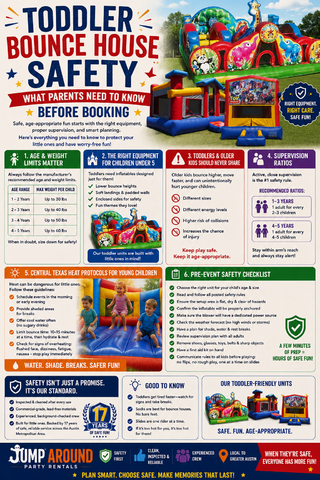
Kids under 5 are not just smaller versions of older children - they have different balance, different heat tolerance, and different collision risk profiles. The safety rules that work for a 7-year-old do not apply the same way to a 3-year-old. This guide covers every toddler-specific standard Jump Around Party Rentals applies, and every rule parents need in place before the first child steps inside.
What this guide covers:
- Age and weight guidelines - minimum ages by equipment type, session limits, supervision ratios
- Right equipment for under 5 - toddler bounce houses vs standard units vs combos
- Why adults should not bounce with toddlers - the rebound force problem explained
- Age separation rules - why toddlers and older kids must never share the same unit
- Central Texas heat protocols - session limits by temperature, mandatory break standards
- Mixed-age party strategies - two-unit approach, staggered time blocks, parallel zones
- Pre-event checklist - 13 items before the first session starts
Browse age-appropriate bounce house options or call (512) 294-2221 - tell us the ages of your youngest guests and we will recommend the right unit.
Jump Around Party Rentals - Greater Austin
5 Toddler Bounce House Safety Rules Parents Get Wrong
Never mix toddlers with older children in the same inflatable
This is the single most important rule for toddler bounce house safety. A 7-year-old bouncing in the same unit as a 2-year-old creates a collision risk that supervision cannot fully eliminate. The size, weight, and energy difference between a toddler and an elementary-age child means a single accidental collision can cause a serious fall. Toddlers need their own unit or their own dedicated time window - never shared bounce time with older kids.
Adults should not bounce with toddlers - their weight creates dangerous rebound forces
An adult stepping into a bounce house to supervise a toddler creates a force multiplier problem. When an adult lands on the inflatable surface, the rebound sends lighter children airborne - including in directions and heights they cannot control. Adult supervision for toddlers means standing at the entrance with eyes on the child, not bouncing alongside them. If a toddler needs physical support inside the unit, a lightweight older sibling of similar size is a better companion than a parent.
Combo units with slides and climbing walls are not appropriate for children under 4
A standard combo bounce house with an attached slide is designed for kids 5 and up. The slide height, the climbing wall, and the speed at the bottom are all scaled for older children. Toddlers under 4 should be on a dedicated toddler bounce house or a standard bounce house with a low entry step - not a combo unit. The bounce chamber of a combo can be used by toddlers but the slide and climb should be off limits without direct one-on-one adult assistance.
Toddlers overheat faster than older children - heat management rules are stricter
Children under 5 have less developed thermoregulatory systems than older kids and adults. They overheat faster, communicate heat distress less reliably, and can progress from comfortable to dangerously overheated in a shorter window. In Central Texas heat above 85 degrees, toddler bounce house sessions should be limited to 10 to 15 minutes maximum with mandatory shade and water breaks between sessions. In heat above 90 degrees, outdoor toddler inflatable activity is not recommended without a climate-controlled shade area adjacent to the unit.
Maximum occupancy for toddlers is lower than the unit's posted capacity
Inflatable capacity ratings are set for children of average size - typically school-age children. When the unit is being used exclusively by toddlers ages 2 to 4, apply a lower occupancy standard. A 15x15 bounce house rated for 8 to 10 children should be limited to 4 to 6 toddlers maximum. Less space per child means more collisions. The goal for toddler sessions is open, unencumbered jumping space - not maximum capacity utilization.
Table of Contents
1. Age and Weight Guidelines for Toddlers
| Age | Appropriate Equipment | Not Appropriate | Session Length | Supervision |
|---|---|---|---|---|
| Under 2 | Not recommended for any inflatable | All inflatables | N/A | Keep outside the unit entirely |
| Age 2 to 3 | Toddler bounce house only - low entry, soft walls, open floor | Combo slides, water slides, obstacle courses | 10 to 12 minutes max | 1 adult at entrance per 4 toddlers |
| Age 3 to 4 | Toddler bounce house, small standard bounce house | Combo slides unsupervised, water slides | 12 to 15 minutes | 1 adult at entrance per 6 toddlers |
| Age 4 to 5 | Standard bounce house, combo with adult assistance on slide | Water slides over 18ft unsupervised | 15 to 20 minutes | 1 adult at entrance per 8 children |
Under 2 Years Old - Not Recommended for Any Inflatable
Children under 24 months do not have sufficient balance, fall awareness, or physical coordination for any inflatable surface. The unpredictable movement of the bounce floor creates fall risks that are not manageable with supervision alone. Keep children under 2 out of all inflatable units entirely. This is not a size or weight question - it is a developmental milestone question.
2. The Right Equipment for Children Under 5
Dedicated Toddler Bounce House
The best option for children ages 2 to 5. Toddler bounce houses have lower entry steps, softer wall construction, smaller interior floor area to limit speed of movement, and lower overall height. The design constraints that make them feel less exciting to older kids are exactly the safety features that make them appropriate for toddlers. Browse toddler units in the bounce house catalog.
Small Standard Bounce House (Ages 3 to 5)
A standard 13x13 bounce house works for toddlers ages 3 and up when used during a dedicated toddler-only time window. The entry step height is typically manageable for a 3-year-old with an adult standing by. Limit occupancy to 4 to 5 children at a time. Never use during a mixed-age session.
What to Avoid for Toddlers
Combo bounce houses with attached slides are not appropriate for children under 4 without direct one-on-one assistance. Water slides of any size are not appropriate for children under 4. Obstacle courses are not appropriate for children under 5. Large 15x15 bounce houses during mixed-age sessions are not appropriate for toddlers regardless of how many older children are present.
3. Supervision Standards for Toddler Bounce House Sessions
One Dedicated Adult at the Entrance
Every toddler bounce house session requires one adult stationed at the entrance with no other duties. This person counts children in, enforces the occupancy limit, watches for falls near the entrance step, and manages children entering and exiting simultaneously. This is a dedicated role - not a person also managing food, taking photos, or watching other activities.
Eyes On Every Child, Every Moment
Toddler supervision is not periodic checking - it is continuous visual contact. A 2-year-old can fall and be unable to get up in a bounce house faster than an adult can respond to a sound alert. The supervisor must be able to see every child in the unit at all times. If the unit is large enough that some children are out of sightlines from the entrance, a second adult inside - positioned near the back wall without actively bouncing - is required.
No Shoes, No Sharp Objects, No Food
Shoes must be removed before entering. Check for jewelry, hair clips, and any sharp accessories - these create laceration risks in a bounce house fall. No food or drinks inside the unit. Sippy cups and snacks need to stay outside and be given during the mandatory break period between sessions.
Mandatory Session Breaks
Clear all toddlers out of the unit every 10 to 15 minutes for a water and shade break. This is non-negotiable in any weather above 80 degrees. Use the break to check children for any signs of heat distress - flushed face, unusual fatigue, excessive sweating, or irritability beyond normal. In Central Texas heat, these breaks are a safety protocol, not a scheduling preference.
4. Age Separation - Why It Is Non-Negotiable
The most common cause of bounce house injuries at mixed-age events is collision between children of significantly different sizes and ages. A 7-year-old does not intend to harm a 3-year-old - but the size and energy difference means a collision during active bouncing can send a toddler into a wall or floor with significant force. Supervision cannot prevent what physics will cause.
| Approach | Risk Level | Notes |
|---|---|---|
| Separate unit for toddlers + separate unit for older kids | Lowest | Best approach for mixed-age parties. Each age group has appropriate equipment and no shared airspace. |
| Same unit, separate time blocks by age | Low | Toddlers bounce 9 to 10 AM, older kids bounce 10 to 11 AM. Clear all toddlers before older group enters. Clean entry step between groups. |
| Same unit, divided by a supervisor standing in the middle | Moderate | Works only in very large units with a physical divider. One adult bouncing in the middle to create a barrier is not effective and creates additional rebound risk for toddlers. |
| Mixed ages simultaneously with no separation | High | The most common setup at backyard birthday parties and the most common cause of bounce house injuries at mixed-age events. Avoid entirely. |
5. Heat Safety for Toddlers in Central Texas
| Ambient Temperature | Toddler Bounce Activity | Session Limit | Required Measures |
|---|---|---|---|
| Under 80F | Full activity | 15 to 20 min | Water available, sunscreen applied before activity |
| 80F to 85F | Activity with breaks | 12 to 15 min | Mandatory water break between sessions, shade station within 20 feet |
| 85F to 90F | Shortened sessions only | 10 min max | Mandatory 10-min shade and water break between sessions, adult monitoring for heat signs |
| 90F to 95F | Morning only, before 10 AM | 8 min max | Climate-controlled shade required adjacent to unit, continuous hydration, no afternoon sessions |
| Above 95F | Not recommended | Discontinue | Outdoor toddler inflatable activity should not occur above 95 degrees without indoor or climate-controlled alternatives |
For full Central Texas heat protocols applicable to all age groups, see the outdoor event heat planning guide. Toddler-specific heat thresholds are stricter than those listed for general events.
6. Mixed-Age Party Strategies That Work
Two Units, Two Zones
The cleanest solution for a birthday party with toddlers and elementary-age kids. Rent a small toddler bounce house for the under-5 crowd and a standard bounce house or combo for older kids. Position them in separate areas of the yard. Each group has their own space, their own rules, and their own adult supervisor. Jump Around Party Rentals delivers and sets up both in one trip.
Staggered Time Blocks
One unit, two time windows. Toddlers bounce from 2:00 to 2:30 PM. Older kids bounce from 2:45 to 3:30 PM. Clear transition between groups. This works if you have fewer than 10 toddlers and fewer than 15 older children. It requires an adult assigned specifically to manage the transition and enforce the time blocks - it will not self-manage.
Parallel Activity Zones
Toddlers in the bounce house. Older kids at a dunk tank, obstacle course, or water slide. Both groups active simultaneously in separate areas with separate supervisors. This eliminates wait time for older kids while toddlers have their session and avoids the pressure to cut toddler sessions short because older kids are waiting.
7. Toddler Bounce House Pre-Event Safety Checklist
Before the Unit Arrives
Before Each Session
8. Toddler Bounce House Safety FAQ
What age can a child use a bounce house?
The minimum safe age for any inflatable is 2 years old, and only on a dedicated toddler bounce house with one-on-one supervision and strict occupancy limits. Children under 2 should not use any inflatable. Children ages 2 to 3 should only use toddler-specific units - not standard bounce houses or combo units. Ages 4 and 5 can use standard bounce houses during toddler-only sessions. See the full age and equipment breakdown above for specific guidelines by age. For general safe inflatable rental practices, see the rental safety resource.
Can toddlers and older kids use the same bounce house?
No. Toddlers and older children should never share the same inflatable at the same time. The size, weight, and energy difference between a 3-year-old and a 7-year-old means accidental collisions can cause serious falls regardless of how closely adults supervise. Separate units or separate timed sessions by age group are the two safe options for mixed-age parties. The two-unit approach - a toddler bounce house alongside a standard unit for older kids - is the cleanest solution.
How long should a toddler bounce house session last?
10 to 15 minutes per session in mild weather, with a mandatory water and shade break between sessions. In temperatures above 85 degrees, limit sessions to 8 to 10 minutes with a 10-minute mandatory break. In temperatures above 90 degrees, morning-only sessions of 8 minutes maximum with full shade adjacent to the unit. Above 95 degrees, outdoor toddler inflatable activity is not recommended.
Can a parent bounce with their toddler in a bounce house?
No. Adults should not bounce in a unit with toddlers. When an adult lands on the inflatable surface, the rebound sends lighter children airborne in uncontrolled directions. Adult supervision means standing at the entrance with continuous visual contact - not entering the unit. If a toddler needs physical comfort or assistance, a lightweight older sibling is a better companion inside the unit than an adult.
What is the best bounce house for a 2-year-old birthday party?
A dedicated toddler bounce house with a low entry step, soft enclosed walls, and a smaller floor area than standard units is the right choice for a 2-year-old birthday party. Avoid combo units with slides, obstacle courses, and any unit designed for school-age children. Browse bounce house options and filter by age group, or call (512) 294-2221 and describe your guest ages - we will recommend the right unit from the catalog for your specific party.
William Gann
Owner, Jump Around Party Rentals | Round Rock, TX
William Gann has delivered bounce houses to toddler birthday parties, preschool celebrations, and mixed-age family events across the Austin Metropolitan Area since 2008. The age separation standards, supervision ratios, and heat protocols in this guide reflect 15+ years of experience watching what actually keeps the youngest guests safe - and what creates the incidents that parents remember for the wrong reasons.
Jump Around Party Rentals is TDI-compliant, fully insured, and holds 4.76 stars across 932 verified reviews.
About William and Jump Around Party RentalsBook the Right Bounce House for Your Toddler Party
Jump Around Party Rentals delivers age-appropriate inflatables to toddler birthday parties and family events across Williamson County, Travis County, Bell County, and the Austin Metropolitan Area. TDI-inspected, fully insured, delivered and set up by a professional crew. Owner-operated since 2008.
Prices shown are base rates. Pricing may vary for peak dates, delivery distance, or setup surfaces. Taxes not included.
(512) 294-2221
