
School Event Planning
School Field Day Rentals Planning for Greater Austin Campuses
By William Gann, Jump Around Party Rentals • Published: April 2024 • Last Updated: June 13, 2025 • Category: School Events • Reading time: 11 min
COI and TDI documentation for every major school district across the Greater Austin Metro, equipment selection by grade level, station layout for large crowds, heat management protocols for May and June field days, booking timeline, and the complete school event day-of checklist.
Everything Your Campus Needs for Field Day — In One Place
Jump Around Party Rentals has delivered school field day rentals to campuses across the Austin Metropolitan Area since 2008. This guide covers everything a PTA chair, campus coordinator, or field day committee needs to plan a safe, well-run event — from pulling COI for your district to calculating how many stations your headcount requires.
What you will find in this guide:
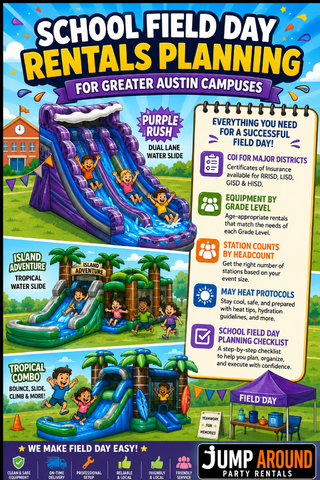
- COI for every major Central Texas district — certificates of insurance ready same-day for any campus
- Equipment by grade level — what works for Pre-K through 5th grade and why mixing ages creates problems
- Station counts by headcount — how many inflatables and activity stations your crowd actually needs
- May and June heat protocols — the timing and safety standards that keep students safe in Central Texas heat
- Campus surface and access requirements — grass, blacktop, turf, and caliche all handled differently
- Complete planning checklist — 21 items from booking through day-of, organized by phase
Ready to book? Call (512) 294-2221 or use the date availability tool to check your field day date. Multi-unit school event orders should be booked by mid-April for May dates.
Jump Around Party Rentals — Greater Austin
6 Things PTA Chairs and School Coordinators Need to Know Before Booking
Every Williamson County school district requires COI before a vendor steps on campus
RRISD, LISD, GISD, HISD, and most other districts in the Greater Austin Metro require a Certificate of Insurance naming the school district as additional insured before any rental equipment arrives on campus property. Jump Around Party Rentals provides COI documentation at no charge request it at booking with your school and district name. TDI registration documentation is also available on request.
May and June field days run in heat morning-only scheduling is the standard protocol
Most Williamson County school field days fall in May and early June peak heat season. Outdoor inflatable activity in afternoon heat above 90 degrees with children ages 5 to 11 requires active heat management. The standard protocol for school field days is 8 AM to 11:30 AM outdoor activity with equipment moved inside or event concluded before peak afternoon heat. Plan your schedule around this window before setting the date.
Station rotation is essential one inflatable for 300 kids does not work
A typical elementary campus field day involves 200 to 500 students cycling through activity stations over a 2 to 4 hour window. A single bounce house handles roughly 40 to 60 riders per hour. Without multiple stations 3 to 6 inflatables or activity units the wait times become longer than the activity time and the event loses energy. Plan your station count based on your student headcount, not your budget alone.
School campuses have specific access requirements confirm before booking
School campuses in Round Rock, Cedar Park, Georgetown, and across Williamson County have vendor access protocols delivery windows, specific entry points, required check-in procedures, and sometimes restrictions on which surfaces equipment can be placed on. Grass fields, paved blacktop, and turf fields all require different anchoring approaches. Confirm your campus access details before delivery day.
Book by mid-April for May field days dates compress fast
May field day dates across Williamson County and Travis County campuses cluster within the same 3 to 4 week window at the end of the school year. Every PTA in the district is trying to book the same week. Multi-unit orders for school events are the first to fill for May dates. Book by mid-April at the latest earlier is better.
Grade-separated stations keep the event safe and age-appropriate
A field day with K through 5th simultaneously on the same equipment creates the same problem as mixing toddlers with 10-year-olds at a birthday party. Kindergartners and 5th graders should not be bouncing together. Stagger grade levels by station time block or assign specific equipment to specific grade levels. The station layout in Section 4 covers how to structure this for different campus sizes.
Table of Contents
1. COI and TDI Documentation What Each District Requires
Every school district in the Greater Austin Metro requires vendor documentation before any rental equipment arrives on campus. Requirements vary slightly by district but follow a consistent pattern. Jump Around Party Rentals is prepared to meet all of these request documentation at booking.
| District | COI Required? | TDI Docs Required? | Additional Insured Named As | Notes |
|---|---|---|---|---|
| RRISD | Yes | Yes | Round Rock Independent School District | Confirm campus-specific access window with your principal's office |
| LISD | Yes | Yes | Leander Independent School District | Some campuses require vendor pre-approval through district office confirm in advance |
| GISD | Yes | Yes | Georgetown Independent School District | Newer campuses east of I-35 may have turf fields confirm surface type |
| HISD (Hutto) | Yes | Yes | Hutto Independent School District | Confirm delivery access some Hutto campuses have restricted morning delivery windows |
| AISD (Austin) | Yes | Yes | Austin Independent School District | Additional vendor approval process may apply check with campus coordinator |
| PFISD (Pflugerville) | Yes | Yes | Pflugerville Independent School District | Confirm field surface and power access at your specific campus |
How to Request Documentation from Jump Around Party Rentals
When booking, provide your school name, district, and the name the COI should list as additional insured. Jump Around Party Rentals sends COI documentation directly typically same-day or next-day. TDI inspection documentation is also available. If your district's vendor approval process requires documentation before the booking is finalized, call (512) 294-2221 directly and we will work through the process with you.
2. Equipment Selection by Grade Level
Different grade levels need different equipment not just different supervision ratios. The wrong equipment for a grade level either bores older students or creates safety concerns for younger ones. Use this as your starting point when building your station list.
Pre-K and Kindergarten
Ages 4 to 6 smaller units, lower energy, dedicated adult per station
RECOMMENDED
- Toddler or small bounce house
- Carnival duck pond games
- Bean bag toss, ring toss
- Snow cone machine station
AVOID
- Standard bounce houses with older grades
- Obstacle courses
- Water slides
- Wrecking ball or competitive inflatables
Grades 1 through 3
Ages 6 to 9 standard bounce houses, light obstacle courses, most popular field day age band
RECOMMENDED
- Standard bounce houses
- Combo units with slides
- 34ft obstacle course
- Inflatable carnival games
- Dunk tank (ages 7+)
NOTES
- Keep 1st grade separate from 3rd if possible
- One dedicated adult per bounce house
- 10-minute rotation windows for this age band
- Hydration break every 20 min in May/June heat
Grades 4 and 5
Ages 9 to 11 competitive and challenge-based equipment; standard bounce houses lose them fast
RECOMMENDED
- 96ft Racing Obstacle Course
- Wrecking Ball
- Double Lane Bungee Run
- Giant Soccer Darts
- Dunk tank with teachers in the seat
NOTES
- Teachers in the dunk tank = massive engagement
- Relay races and timed runs create competition energy
- Higher exertion = shorter safe session windows in heat
- Keep 4th and 5th separate from K-3 equipment
3. How Many Stations Does Your Headcount Require?
The rule of thumb: divide your total student count by the number of 15-minute rotation windows in your event duration. That gives you the number of students per station at any given time. Then confirm each station can handle that load. A standard bounce house handles 6 to 8 riders at once if you need 50 kids per station per rotation, you need multiple inflatables per station or more stations.
| Student Count | Event Duration | Recommended Stations | Suggested Setup |
|---|---|---|---|
| Under 100 students | 2 hours | 3 to 4 stations | 2 bounce houses + obstacle course + game station |
| 100 to 200 students | 2.5 to 3 hours | 4 to 6 stations | 3 bounce houses or combos + obstacle course + dunk tank + 1 to 2 game stations |
| 200 to 350 students | 3 to 3.5 hours | 6 to 8 stations | 3 to 4 inflatables + 96ft obstacle course + dunk tank + 2 to 3 game/carnival stations + concession |
| 350 to 500 students | 3.5 to 4 hours | 8 to 10 stations | 4 to 5 inflatables + 100ft obstacle course + dunk tank + 3 to 4 game stations + 2 concession stations |
| 500+ students | 4+ hours with breaks | 10 to 12 stations | Call for a custom quote large campus events require individual planning. (512) 294-2221 |
These are starting frameworks actual requirements depend on your grade level mix, rotation structure, and field layout. Call Jump Around Party Rentals to build a custom station plan for your campus headcount.
4. Station Layout and Grade Rotation Structure
Grade-Band Separation
The most effective school field day structure divides the event into two or three grade-band time blocks rather than running all grades simultaneously. Example: K and 1st grade from 8 to 9:30 AM, 2nd and 3rd from 9:30 to 11 AM, 4th and 5th from 11 to 12:30 PM. This keeps age groups appropriately matched to equipment, reduces overcrowding at each station, and makes supervision manageable for the teachers and parent volunteers present.
Rotation Windows
15-minute station rotations are the standard for elementary field days. A timer or whistle signal rotates all classes simultaneously one class exits a station, the next enters. This prevents bottlenecking and ensures every student gets equivalent time at each station. For events in May heat, build a 5-minute water and shade break into every rotation transition rather than moving directly from one station to the next.
Positioning on the Field
Arrange stations in a loop rather than a line loop layouts keep traffic moving and prevent classes from stacking behind a single exit point. Place the highest-energy stations (obstacle course, wrecking ball) at the far end of the loop and lower-energy stations (game booths, concessions, dunk tank observation) near the entry. This creates a natural cooldown progression as students cycle back toward the starting point.
Shade and Water Station Placement
Place a water and shade station every 2 to 3 inflatable stations along the loop. Teachers should not need to walk a class 200 feet for water during a rotation break. A tent rental over the water and rest area provides the shade structure. Snow cone or water station at this point doubles as a treat and heat management tool simultaneously.
5. Heat Management for May and June Field Days
The overwhelming majority of school field days in the Greater Austin Metro fall in May or early June. Average highs during this window run 87 to 97 degrees. These are the heat management standards that experienced school event planners use across Williamson County campuses.
| Time Window | Typical Temp (May/June Austin) | Outdoor Inflatable Activity | Protocol |
|---|---|---|---|
| 7:30 to 9 AM | 70 to 78F | Safe minimal precautions | Standard hydration. Light precautions. Best window of the day. |
| 9 to 10:30 AM | 78 to 85F | Safe with precautions | Water break every rotation. Shade available. Monitor younger grades more closely. |
| 10:30 AM to noon | 85 to 93F | Caution active management | Mandatory shade break every rotation. 10-min max bounce sessions. Cold water at every station. Watch K-2 closely. |
| Noon to 2 PM | 90 to 97F | Not recommended for K-3 | Conclude outdoor activity for younger grades. 4th-5th may continue with aggressive hydration, shade, and 10-min rotation maximum. |
Water Supply Planning
Plan 8 to 12 oz of water per student per hour of outdoor activity. For 300 students over 3 hours, that is 720 to 1,080 total servings. Pre-fill water coolers the morning of the event. A snow cone machine supplements water intake and is enormously popular students who resist drinking water will eat a snow cone every time.
Nurse Coordination
Notify your campus nurse before the field day and confirm they are available during the event. Provide them with the day's schedule and the heat warning signs reference. For events in May or June, the nurse should do a brief walkthrough of the field every 45 minutes. Having the nurse's direct number on the field supervisor's phone is standard protocol.
Inclement Weather Backup Plan
May and June in the Austin Metro bring afternoon thunderstorm risk. Build a clear backup plan before the event what happens if lightning develops at 10 AM? Identify which activities can move indoors, which must be suspended, and who makes the call. Communicate the plan to all supervising teachers and parent volunteers the morning of the event.
Full heat management protocols for Greater Austin outdoor events: Central Texas heat planning guide
6. Campus Surface and Access Requirements
| Campus Surface | Common At | Anchoring Method | Notes |
|---|---|---|---|
| Grass field | Older RRISD, LISD campuses | Ground stakes | Best surface. May be hard and dry by late May in drought conditions run sprinklers night before. |
| Blacktop / asphalt | Most campuses playground area | Sandbags | Works well. Sandbag anchoring required. Blacktop absorbs heat position shade tent over waiting areas if event runs past 10 AM. |
| Artificial turf field | Newer GISD, HISD campuses | Stakes or sandbags | Many districts restrict staking on turf fields. Confirm with campus coordinator. Turf surface heats significantly in direct sun shade is essential. |
| Caliche / gravel | Some rural GISD, Liberty Hill campuses | Stakes with ground cloth under unit | Ground cloth required under inflatable to prevent vinyl puncture from loose rock. Mention surface type at booking. |
Power Access on Campus
Most school campuses have exterior electrical outlets on the building perimeter. For events on the far end of a large field, extension cord runs may exceed 100 feet at that distance, voltage drop can affect blower performance. A generator rental is the cleaner solution for large campus fields and eliminates the extension cord trip hazard. Confirm power access points with your custodial staff before delivery day.
7. Booking Timeline for Greater Austin School Field Days
PTA planning begins. Start the conversation with Jump Around Party Rentals now even before your field day date is confirmed. Multi-unit orders for May dates are the first to fill. Getting on the calendar early guarantees your date and allows time to work through COI and district approval processes.
Book now for May dates. Mid-March is the practical deadline for securing a multi-unit May field day order. Later than this and popular configurations large obstacle courses, multiple bounce houses, dunk tanks may not be available together on your specific date.
COI and logistics confirmed. Request COI with district name as additional insured. Confirm campus access window, surface type, power access, and water access with custodial staff. Share the station layout plan with your principal and PTA team for input.
Final logistics check. Confirm delivery window with Jump Around Party Rentals. Brief supervising teachers and parent volunteers on rotation schedule, safety rules, and heat protocols. Assign station supervisors. Purchase water supply.
Final prep. Check 10-day and hourly weather forecast. Pre-fill water coolers. Confirm vendor contact number saved in coordinator's phone. Alert campus nurse of event timing. Identify indoor backup space if needed.
8. School Field Day Planning Checklist
Administrative (Weeks Before)
Logistics (Week Before)
Day Of
9. School Field Day FAQ
Does Jump Around Party Rentals provide COI for RRISD and LISD campuses?
Yes. Jump Around Party Rentals provides COI documentation at no charge for all school campuses across RRISD, LISD, GISD, HISD, PFISD, and AISD. The district is named as additional insured at no additional cost. TDI registration documentation is also available on request. Provide your school name and district at booking and COI is sent same-day or next-day.
How many bounce houses do I need for a 400-student field day?
For 400 students over a 3.5 to 4 hour event with 15-minute rotation windows, plan for 8 to 10 stations total. This typically means 3 to 4 bounce houses or combo units, a large obstacle course, a dunk tank, 2 to 3 carnival game stations, and at least one concession station. No single bounce house handles 400 students on its own the station count is what makes a large field day work. Call (512) 294-2221 to build a custom multi-unit plan for your specific headcount and campus layout.
When should I start planning a school field day rental in the Austin Metro?
Start planning in February for May field days. The Greater Austin Metro has hundreds of elementary campuses across every Greater Austin Metro school district all scheduling field days in the same 3 to 4 week window at the end of the school year. Multi-unit orders fill by mid-March. Waiting until April for a May date almost always means your preferred configuration is no longer available on your specific date. Use the date availability tool to check and hold your date as soon as it is confirmed.
What happens if it rains on our school field day?
Light rain does not automatically shut down a field day but lightning does clear all inflatables and move students inside immediately at the first lightning strike. Confirm Jump Around Party Rentals' weather and cancellation policy at booking so you know your options before event day. May and June in the Austin Metro carry afternoon storm risk. Build your event schedule to be concluded or moved inside by noon to minimize afternoon weather exposure. Ask for the written cancellation policy in writing before paying any deposit. See the inflatable rental safety tips for full weather protocol guidance.
Can inflatables be set up on artificial turf at school campuses?
Yes, with the right anchoring. Artificial turf fields at newer GISD and HISD campuses can accommodate inflatable equipment using sandbag anchoring when staking is not permitted. Some districts restrict staking on turf to protect the playing surface. Mention artificial turf at booking so the crew brings sandbags rather than stakes. Turf surfaces absorb significant heat in direct sun shade tent placement over waiting areas is especially important for turf field events in May and June.
William Gann
Owner, Jump Around Party Rentals | Round Rock, TX
William Gann has delivered inflatable rentals to school field days and campus carnivals across school campuses across the Greater Austin Metro since 2008. The COI process, district documentation requirements, station counts, rotation windows, and May heat protocols in this guide come from 15+ years of actual school event deliveries across Greater Austin. Jump Around Party Rentals is one of the most experienced school event vendors operating in Williamson County.
TDI-compliant, commercially insured, COI provided at no charge. 4.76 stars across 932 verified reviews.
About William and Jump Around Party RentalsBook Your School Field Day Rental
Jump Around Party Rentals delivers TDI-inspected, fully insured inflatables to school campuses across Williamson County, Travis County, Bell County, and the Greater Austin Metro. COI provided at no charge. Owner-operated since 2008.
Prices shown are base rates. Pricing may vary based on order size, delivery distance, or peak dates. Taxes not included.
(512) 294-2221
